A reflection on John 2:13–22 // Mark 11:15–19
Une réflexion sur Jean 2,13–22 // Marc 11,15–19
📌 Version française ci-dessous | French version below
🇬🇧 The True Temple
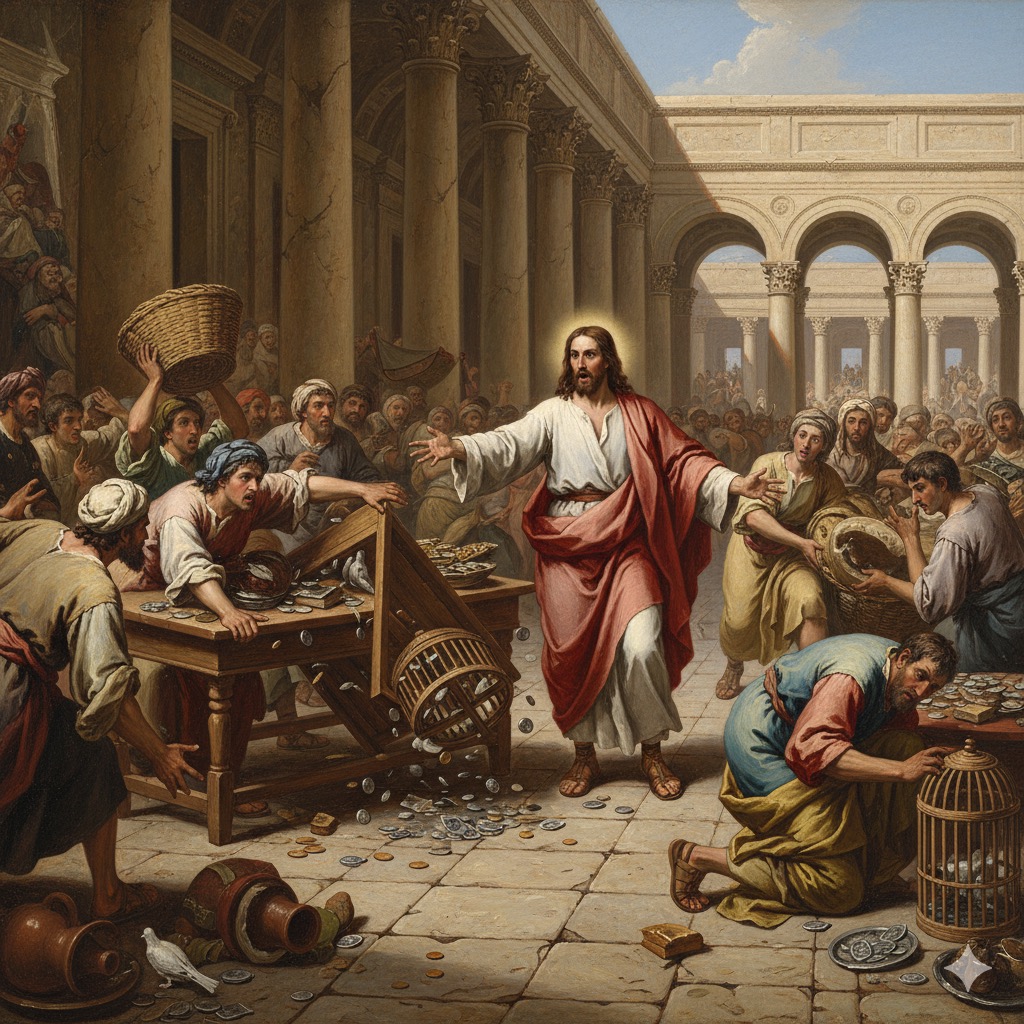
All four Gospels recount the episode in which Jesus drives the merchants out of the Temple. But John places it at the very beginning of Jesus’ public ministry, whereas the Synoptic Gospels (Mark, Matthew, and Luke) locate it just before the Passion.
This difference in chronology reveals above all a difference in meaning.
1️⃣ In Mark: A Sign of Judgment
Mark frames the Temple episode with the story of the barren fig tree (Mark 11:12–21). This mirrored narrative shows that the Temple has become barren—it no longer bears spiritual fruit.
Jesus does more than denounce commercial activity: he prevents any cultic action from taking place, effectively halting sacrifice itself.
And at his death, “the curtain of the temple was torn in two, from top to bottom” (Mark 15:38).
👉 The Temple is thus rendered obsolete: through the death of Jesus, access to God is no longer mediated—it is opened to all.
2️⃣ In John: The Temple Replaced by the Presence of the Lamb
John situates the cleansing of the Temple at the beginning of his Gospel (John 2:13–22).
This choice must be read in light of the Gospel’s opening presentation of Jesus as “the Lamb of God who takes away the sin of the world” (John 1:29).
In Jewish tradition, the lamb symbolized the entire sacrificial system through which the people maintained their relationship with God. By applying this title to Jesus, John announces that communion with God no longer requires the mediation of the Temple: God now offers forgiveness and closeness directly through the presence of his Envoy.
Thus, Jesus’ gesture in the Temple signifies that the time of the old worship has passed. From now on, the true place of encounter with God is no longer a sacred space, but a person—Christ himself:
“The hour is coming, and is now here, when the true worshipers will worship the Father in spirit and truth” (John 4:23)
3️⃣ From the Temple of Stone to the Living Temple
Mark and John agree on the essential point: the old Temple no longer has meaning.
But whereas Mark presents this as a sign of an ending, John presents it as the revelation of a new beginning: God no longer dwells in a sanctuary made of stone, but lives among human beings in the person of Jesus—and, through him, in every believer who becomes a dwelling place of God.
👉 Thus, Jesus’ action in the Temple is not merely an outburst of anger but a revelation: the old cult gives way to a living presence—the presence of God drawing near to humanity in his Son.
🇫🇷 Le vrai Temple
Les quatre évangiles rapportent le geste de Jésus chassant les vendeurs du Temple. Mais Jean le place au tout début de la vie publique de Jésus, tandis que les évangiles synoptiques (Marc, Matthieu et Luc) le situent juste avant la Passion.
Une différence de chronologie qui révèle surtout une différence de sens.
1️⃣ Chez Marc : un signe de jugement
Marc encadre l’épisode du Temple par celui du figuier stérile (Marc 11,12–21). Ce double récit en miroir montre que le Temple est devenu stérile : il ne porte plus de fruit spirituel.
Jésus ne se contente pas d’y dénoncer le commerce : il empêche toute activité cultuelle, rendant impossible le sacrifice.
Et à sa mort, le voile du sanctuaire se déchire (Marc 15,38).
👉 Le Temple est donc rendu caduc : par la mort de Jésus, l’accès à Dieu n’est plus médiatisé — il est ouvert à tous.
2️⃣ Chez Jean : le Temple remplacé par la présence de l’Agneau
Jean place la scène du Temple dès le début de son évangile (Jean 2,13–22).
Ce choix doit se lire à la lumière de la présentation inaugurale de Jésus comme « l’Agneau de Dieu qui enlève le péché du monde » (Jean 1,29).
Dans la tradition juive, l’agneau symbolise l’ensemble du culte sacrificiel, par lequel le peuple maintenait sa relation avec Dieu. En appliquant ce titre à Jésus, Jean annonce que la communion avec Dieu n’a plus besoin d’être médiée par le Temple : Dieu offre désormais le pardon et la proximité directement par la présence de son Envoyé.
Ainsi, le geste de Jésus au Temple manifeste que le temps du culte ancien est révolu. Désormais, le vrai lieu de rencontre avec Dieu n’est plus un espace sacré, mais une personne, le Christ lui-même :
« L’heure vient, elle est là, où les vrais adorateurs adoreront le Père en esprit et en vérité » (Jean 4,23).
3️⃣ Du Temple de pierre au Temple vivant
Marc et Jean se rejoignent sur le fond : le Temple ancien n’a plus raison d’être.
Mais là où Marc en fait un signe de fin, Jean en fait une révélation d’un commencement : Dieu n’habite plus un sanctuaire de pierre, mais demeure au milieu des hommes en la personne de Jésus, et, à travers lui, en tout croyant devenu demeure de Dieu.
👉 Ainsi, le geste de Jésus au Temple n’est pas seulement un acte de colère, mais une révélation : le culte ancien cède la place à une présence vivante, celle du Dieu qui se rend proche en son Fils.
 Biblical Readings